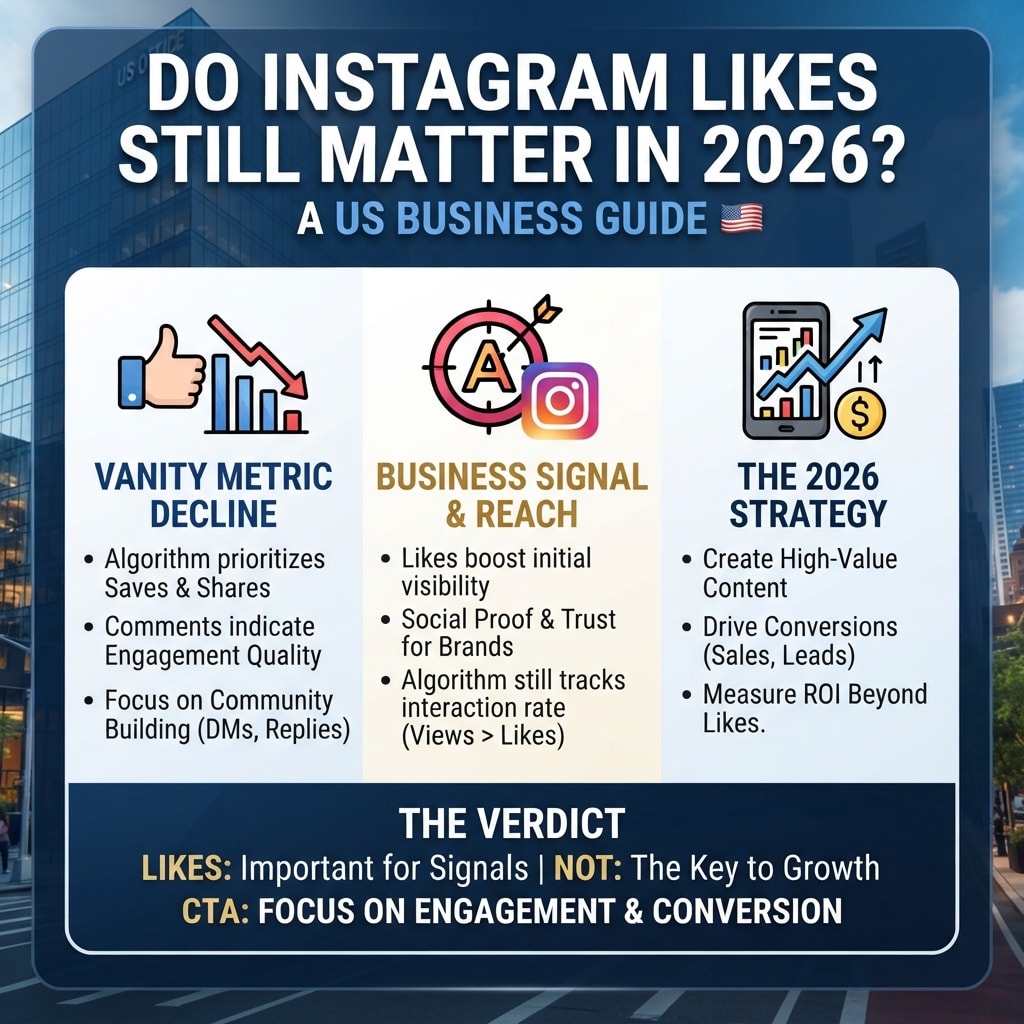
Do Instagram Likes Still Matter in 2026? A Guide for US Businesses
Contents
- Do Instagram likes still matter in 2026?
- What can a like tell a business?
- How to calculate Instagram likes per reach
- Which Instagram engagement signals should US brands track?
- Comments
- Saves
- Shares and sends
- Profile visits and website actions
- A simple way to compare two posts
- How to measure whether Instagram likes help your business
- Set one main goal
- Keep a basic record
- Compare similar posts
- Connect activity with business results
- How to earn more meaningful Instagram likes
- Are paid likes and comments a good growth plan?
- A practical way to judge Instagram likes
Instagram likes still matter in 2026, but they do not tell the whole story. A like shows that someone chose to respond to a post. It does not prove that the person read the caption, trusts the business, or plans to buy.
For US businesses, likes work best as one part of a wider picture. Compare them with reach, comments, saves, shares, profile visits, and sales actions. These measures can help you see which posts catch attention and which ones move people toward a goal.
This guide explains how to measure Instagram likes, how to compare posts fairly, and what to do with the results. It also covers an important point for any business considering paid engagement. Instagram’s rules matter, so check them before choosing a service.
Do Instagram likes still matter in 2026?
Yes. Likes can show that people responded to a post, and Instagram’s head has named likes per reach as a useful measure. But likes alone do not prove that a post reached new people or helped your business earn sales.
In a public video, Instagram head Adam Mosseri said creators focused on reach should watch average watch time, likes per reach, and sends per reach. This advice puts likes in context. A raw like total is hard to judge without knowing how many people saw the post.
For example, a post with 80 likes from 1,000 people reached may have performed better with viewers than a post with 150 likes from 5,000 people reached. The second post earned more likes, but fewer viewers liked it as a share of its reach.
Instagram also provides a Best Practices section in the professional dashboard. It offers guidance on creation, engagement, reach, and other areas. Check the dashboard for current advice that applies to your account. Meta’s overview of Instagram Best Practices
What can a like tell a business?
A like is a quick sign of interest. Someone may have liked a product photo, agreed with a tip, or enjoyed a Reel. When you compare similar posts, likes can help you spot topics or styles that catch attention.
They can also help you test a creative choice. Imagine a home decor shop shares two photos of the same lamp. One shows the lamp on a plain background. The other shows it in a furnished room. If the second photo earns more likes per person reached, the setting may have helped viewers picture the product at home.
That result is a clue, not proof. The post may have appeared at a better time, or reached people with stronger interest. Test the idea again before changing your whole content plan.
Likes also have limits. Many people view a post without tapping anything. Some like a post and never return. So treat a like as feedback about the post, not as a promise of future action.
How to calculate Instagram likes per reach
Divide the number of likes by the number of accounts reached, then multiply by 100. This gives you the percentage of reached accounts that liked the post.
For example, a post gets 80 likes and reaches 2,000 accounts.
80 divided by 2,000, then multiplied by 100, equals a 4 percent like rate by reach.
A second post gets 100 likes and reaches 5,000 accounts. Its rate is 2 percent. The second post earned more likes in total, but the first received likes from a larger share of its audience.
Use this calculation to compare posts with similar goals and formats. A Reel, a product photo, and a customer story may perform in different ways. Comparing them as if they served the same purpose can lead to the wrong lesson.
Also keep the time period consistent. Compare posts after the same number of days, such as seven days after publishing. One post may have been live longer and had more time to collect likes.
Which Instagram engagement signals should US brands track?
Likes are useful, but other actions can tell you more about what viewers did next. Choose measures that match the goal of each post.
Comments
Comments take more effort than likes. They may show that a post raised a question or gave people a reason to share an opinion. Read the comments instead of looking only at the count. A few real questions can offer useful customer insight.
Saves
A save may mean that someone wants to return to the post later. Tips, checklists, and product care advice often give people a reason to save. Track saves to learn which posts have lasting use.
Shares and sends
A share suggests that someone found a post worth passing along. It can help the post reach beyond your current audience. Mosseri has also named sends per reach as a measure to watch when seeking reach.
Profile visits and website actions
A post can earn a modest number of likes and still bring many people to your profile. That may be a strong result if the goal is to gain leads or sell a product. Track link taps, calls, sign ups, or orders when possible.
Emplifi’s Q3 2026 report measured a 1.51 percent Instagram engagement rate per impression for US brand posts. The report analyzed data from more than 11,000 US Instagram profiles. It defines the rate as interactions divided by impressions. Treat this as one vendor’s benchmark, not a target for every account or industry. Read Emplifi’s findings and methodology
A simple way to compare two posts
A small business can learn a lot from a basic weekly review. The example below shows how a US coffee shop might compare two posts about a seasonal drink.
MeasurePost APost BAccounts reached1,2002,000Likes7280Likes per reach6 percent4 percentSaves826Website visits519
Post A earned more likes for its reach. Post B reached more people and led to more saves and website visits. If the shop only wanted to learn which post viewers liked more, Post A looks stronger. If the shop wanted to drive menu visits, Post B may be more useful.
This example does not prove why Post B led to more visits. The caption, audience, timing, or image may have played a part. The owner could test the same style again and compare the next set of results.
How to measure whether Instagram likes help your business
Choose a goal for each post, record the same measures each week, and compare similar content. Then check whether likes connect with a useful next step, such as a profile visit or sale.
Set one main goal
Before you publish, decide what you want the post to do. A product photo may aim to bring people to your profile. A how to Reel may aim to earn saves. A customer story may aim to start a conversation.
One post can support more than one goal, but choose a main one. This keeps your review simple and helps you select the right measure.
Keep a basic record
Use Instagram Insights or a trusted analytics tool. Record the date, format, topic, reach, likes, comments, saves, shares, profile visits, and website actions. You do not need a complex dashboard. A simple sheet can show patterns after a few weeks.
Compare similar posts
Compare Reels with Reels, product photos with product photos, and posts with similar goals. Look for patterns across several posts rather than judging one post alone. A single result can change because of timing or chance.
Connect activity with business results
If sales matter, use trackable links or campaign codes. Website analytics can show whether visitors came from Instagram and whether they made a purchase. A post with fewer likes may still bring the right customers.
How to earn more meaningful Instagram likes
Share content that helps a clear audience, make the main point easy to see, and give viewers a useful reason to respond. Review the results and repeat ideas that support your goal.
Start with a real customer need. A local shop can answer common questions, show how a product works, or compare options. A service business can explain its process or share a client story with permission.
Make each post easy to follow. Use a clear opening, helpful images, and short captions. For Reels, show the topic early so viewers know what they will learn or see.
Invite a response that suits the post. Ask for a preference when comparing two options. Offer a next step when sharing a guide. Avoid asking people to like a post without giving them a reason.
Then review your results. If a set of practical tips earns more saves and profile visits, make more posts that solve similar problems. If a product photo earns likes but few visits, try a clearer call to view the item. Small tests give you better clues than guesswork.
Are paid likes and comments a good growth plan?
Paid engagement may raise a visible count, but a high count does not guarantee real interest, reach, or sales. Instagram’s Community Guidelines tell users not to artificially collect likes, followers, or shares. Review the rules before choosing an engagement service. Do not share your password, and be cautious of promises that guarantee growth.
Businesses researching Instagram services should check what the service provides and how it works. You can review IG Likes as one option while considering your goals and Instagram’s rules. If you are comparing comment services, read about Purchase Instagram Comments with the same care.
Keep your expectations clear. A purchased number is not proof that customers value a product. Real comments, repeat visits, useful questions, and sales offer stronger signs of audience interest. If a service does not explain its methods, terms, and risks, pause before using it.
A practical way to judge Instagram likes
Instagram likes still offer useful feedback in 2026. They can show that a post caught attention and help you compare similar content. They cannot explain the full path from first view to purchase.
For a better view, track likes per reach along with comments, saves, shares, profile visits, and sales actions. Compare similar posts over the same time period. Use the results to make one change at a time.
This approach keeps likes in their proper place. They are one clue about your content, not the only measure of success.
Frequently Asked Questions
Do likes help Instagram posts reach more people?
Likes per reach can be a useful signal, according to Instagram’s public guidance. However, likes do not guarantee wider reach. Watch time, sends, content, and other factors may also affect distribution.
What is a good like rate on Instagram?
There is no single rate that fits every account or industry. Compare similar posts from your own account and watch the trend over time. Use public benchmarks as context, not as a fixed goal.
Should a business focus on likes or sales?
Choose measures that match your goal. Likes can show interest, while website actions and sales show stronger business outcomes. Track both to understand how people move from a post to a purchase.


